
AI/ML Hiring in India 2026 - The 5 Stats You Need to Know
The AI talent gap is growing. Is your hiring strategy ready?

Asha Kiran Nambala
Digital Marketing Manager • Hiringhood
Key Highlights:
- AI talent shortage in India is widening as the demand for AI/ML talent continues to exceed the current talent supply.
- AI hiring trends in 2026 show that demand for AI/ML professionals is expanding into multiple industries like healthcare, banking, retail and many more beyond big tech companies.
- With increasing AI adoption, the demand for data scientists and generative AI professionals has skyrocketed.
- Hiring leaders are leveraging AI-powered recruitment platforms to reduce time-to-hire to 7 days.
- The biggest hiring challenge is finding job-ready AI talent with a blend of technical expertise and business understanding.
The evolution of technology has continuously influenced hiring trends over the decades. In the late 1990s, organisations raced to fill software engineering roles as the internet was taking off. A decade later, mobile developers became one of the hottest professions. Now, the hiring world is witnessing another transformation, as organisations turn their attention to experts who can design, develop, train, and manage intelligent AI systems.
For talent acquisition leaders, this means the search for AI/ML talent is no longer limited to big tech firms. Startups, banks, healthcare organisations, retailers, manufacturers, and traditional businesses are all vying for the same talent pool, leading to longer hiring cycles where time becomes a crucial recruitment advantage. Even organisations with the right employer branding fail to secure the top talent and fill the position.
But what if you could hire your next AI/ML professional in just 7 days by optimising your hiring process? Let’s find out at the end of this blog.
01 Demand for AI/ML Talent Will Continue to Exceed Supply
Hiring AI talent in 2026 is like hiring qualified architects during a construction boom. Everyone wants to build, but the pool of skilled professionals remains limited. India has become one of the world’s largest technology talent hubs, but the AI talent shortage continues to widen as the demand for AI talent is outgrowing the supply. According to NASSCOM, India is expected to need over a million AI and ML-skilled professionals by 2026, while the current talent supply is significantly lower than the demand.
Key Statistics from NASSCOM:
SUPPLY
DEMAND
51% Talent Gap
The deficit between current supply and immediate market needs.
Job openings for ML engineers, AI developers, data scientists, and AI product specialists are rising year after year. This surge isn’t limited to AI-centric roles, as organisations are looking to integrate AI into their:
Thus, talent acquisition teams are hiring not only dedicated AI developer roles but also for positions that require AI/ML skills. In such a competitive market, offering higher salaries and attractive benefits is no longer enough. AI/ML professionals prioritise continuous learning, technical autonomy, work environment flexibility, and the opportunity to engage in real-world problems with AI.
02 What’s Driving the AI Talent Shortage in India?
The talent shortage in the AI space is no longer a future concern; it is happening today, and many organisations report that it is a competitive challenge to fill AI/ML roles with qualified professionals. Most hiring managers note that only a small percentage of applicants possess the combination of technical and practical skills to fill AI/ML positions.
Some candidates may have strong theoretical knowledge and coding skills but lack hand-on experience with developing and deploying machine learning models. Others may have the technical expertise but struggle to analytically apply AI solutions to solve business problems.
The top hiring challenges in the AI space include:
Hence, the main problem is not lack of applicants but the inability to find professionals who have the required expertise and can hit the ground running. As more companies invest in data science and AI/ML, recruiters must implement smarter sourcing strategies and utilise innovative assessment solutions to find the best candidates.
03Statistical Growth in Modern Technological Advancement Talent
The surge in demand for machine learning jobs is just a part of a larger trend, as companies invest in data science and AI roles across industries. Data is the new oil, and companies are willing to invest in data science expertise to extract value.
According to recent hiring reports, AI/ML roles have been growing by 25-35% YoY, and AI engineering job postings in India grew by 59.5% YoY, the highest growth among major global markets. While data science positions are rising across industries like finance, healthcare, retail, and manufacturing.
Leading modern technology-driven roles that are high in demand:
With more companies adopting hybrid and remote work policies, tier-2 cities are emerging as promising talent destinations. More businesses in logistics, banking, e-commerce, pharma, and telecom are looking to build analytics and AI teams. The next five years will witness the creation of thousands of data science and AI/ML roles that did not exist a decade ago.
04Hunting for experience without ignoring potential talent
General-purpose AI recruiting tools do a perfectly good job for standard roles. But once you're hiring for AI engineers, ML engineers, MLOps engineers, Data Engineers, or Generative AI engineers, the gap between "a good tool" and "the right tool" becomes hard to ignore.
One of the interesting trends in AI hiring is that while most companies continue to seek experienced professionals, organisations are also looking at potential candidates. Many businesses are willing to train entry-level and mid-career professionals with the right skill set.
While companies are looking for senior ML engineers with years of experience, organisations are also considering candidates from related fields, such as software engineering and data analysis. Many firms are investing in training junior data scientists and analysts to fill essential AI/ML roles.
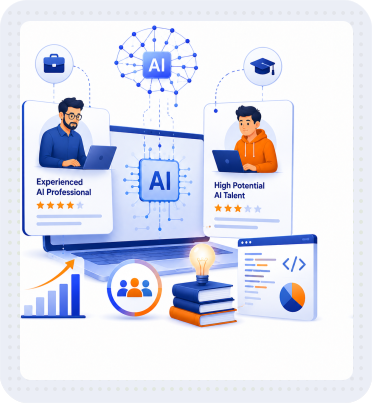
Reports indicate that most companies are looking to hire professionals with at least 2 years of experience. At the same time, organisations are also looking at candidates with specialised degrees and relevant projects.
Reports indicate that most companies are looking to hire professionals with at least 2 years of experience. At the same time, organisations are also looking at candidates with specialised degrees and relevant projects.
Roles typically close in under 7 days - a direct result of the sourcing network, scoring model, and candidate pool all being calibrated around one talent category, rather than stretched thin across every role type imaginable. For companies hiring AI/ML talent in India, from early-stage startups to enterprises like Wipro and ATMECS (now part of Sutherland), that level of specificity tends to matter more than the broader feature set of a general-purpose platform.
05Average time to hire a potential AI/ML talent
The average time to fill AI/ML roles in India takes between 45 and 90 days on an average, which is a significant challenge for tech companies. It may take even longer to fill senior roles, as the hiring process involves multiple stages. But in 2026 you can hire an AI/ML talent in just 7 days. How?
It is noted that the reasons for the lengthy hiring process are caused by
Multiple interview stages
Limited candidate supply
Prolonged decision-making
Counteroffers from others
Difficulty in evaluating skills
Thus, every additional week during the hiring process can lead to the loss of a qualified candidate. But by leveraging modern hiring technologies, organisations can reduce time to hire while improving the candidate experience.
Smarter hiring solutions like Hiringhood can cut time by 60% and find top AI/ML talent in just 7 days. It combines AI-driven sourcing, pre-vetted talent pools and smart screening into a single ecosystem where it enables TA teams to identify, evaluate and hire qualified AI/ML professionals by skipping the lengthy traditional process while maintaining hiring quality.
By accessing hiringhood, organisations can significantly reduce time-to-hire and improve recruitment efficiency, automate candidate matching, end-to-end hiring workflows and build high-performing AI teams. For companies that want to build AI teams, speed is no longer a luxury but a necessity.
06How Talent Acquisition Must Adapt
The average time to fill AI/ML roles in India takes between 45 and 90 days on an average, which is a significant challenge for tech companies. It may take even longer to fill senior roles, as the hiring process involves multiple stages. But in 2026 you can hire an AI/ML talent in just 7 days. How?
Modern companies are also utilising smart hiring technologies to build stronger talent pipelines and improve the quality of hires. These solutions enable organisations to optimise the hiring process and make better recruitment decisions.
07Top AI hiring trends 2026
Some of the most significant trends in AI hiring include
Skills-based recruitment and prioritising real-world experience
Investment in internal training programmes.
Adopting remote hiring practices and utilising innovative hiring technologies to improve their talent acquisition strategies.
Leverage modern smart hiring technologies to reduce time-to-hire.
Organisations that want to hire in the AI space must be aware of the trends and prepare their hiring strategies accordingly.
The demand for AI and ML expertise continues to rise, but the competition for talent is equally intense. The five stats above demonstrate that while organisations want to fill AI roles, the market is challenging for recruiters.
Companies that utilise smart hiring strategies and innovative recruitment technologies will be the most successful in winning the battle for AI talent.
Share this article:
Copy Link LinkedIn
 Twiter / XEmail
In This Article
1. Demand for AI/ML Talent Will Continue to Exceed Supply2. What’s Driving the AI Talent Shortage in India?3. Statistical Growth in Modern Technological Advancement Talent4. Hunting for experience without ignoring potential talent5. Average time to hire a potential AI/ML talent6. How Talent Acquisition Must Adapt7. Top AI hiring trends 2026Hire AI/ML Talent in Days, Not Months
Join 500+ companies leveraging Hiringhood to hire exceptional talent with unmatched speed and accuracy.



FAQ
Frequently Asked Questions
Frequently Asked Questions
Everything you need to know about AI/ML hiring trends in India. Can't find what you're looking for? Our team is one message away.
AI adoption is growing in finance, healthcare, retail, manufacturing, and tech industries, fuelling the demand for skilled professionals.
Limited supply of qualified professionals, prolonged hiring cycles, and intense competition for talent are some of the main challenges.
Businesses can invest in targeted sourcing, skills-based assessments, faster interview processes, and smart hiring technologies like hiringhood.
AI/ML Hiring in India 2026 - The 5 Stats You Need to Know
AI talent shortage in India is widening as the demand for AI/ML talent continues to exceed the current ta …
The Ultimate Guide to AI Tools for Recruiters in 2026
Recruiting has shifted more in the last two years than it did across the previous two decades combined Team...
Why India Needs a Recruitment Marketplace for AI/ML Hiring ?
Artificial Intelligence (AI) and Machine Learning (ML) are no longer futuristic buzzwords — they are transf…