
What the Best AI Teams Look Like in 2026
How the right people, skills, and structure turn AI into business impact.

Asha Kiran Nambala
Digital Marketing Manager • Hiringhood
AI has long surpassed the experimental phase. It has become a business imperative that drives ROI. Walk into any organisation, and you are likely to find AI initiatives in various stages of development, from a chatbot pilot in customer support to a forecasting model in finance and a generative AI tool in marketing.
Yet, despite the billions poured into AI initiatives, many organisations find it hard to extract business value from their efforts. The issue is rarely technology, since the most sophisticated AI models and enterprise tools are now within reach of most organisations. The key differentiating factor is people, specifically the right AI team structure that can deliver on the promise of innovation.
Organisations that excel at AI in 2026 have mastered how to build an AI team. They are not defined by the technical capabilities of their tools but by their ability to assemble an AI team structure that drives business impact. After closely observing how AI teams succeed, here are the characteristics the best AI teams in 2026 have in common.
Let’s discuss in detail how these characteristics contribute to building the best AI teams in 2026.
01 They are Built Around Business Goals, Not Technology
Many organisations begin their AI journey by prioritising the technology and capabilities of AI models instead of focusing on business outcomes. However, the most successful teams adopt the opposite approach, focusing on business goals and objectives and identifying the role of AI in achieving them.
Whether the goal is to reduce costs, improve customer experience, drive productivity, or enable innovation, the best AI teams look at technology as a means to achieving that goal.
This realisation is influencing AI hiring strategy in 2026, as recruiters are increasingly prioritising business acumen to hire the right talent that best fits the organisation's goals. Ultimately, the most successful AI teams are not defined by the best technology but by their ability to solve the right problems.
02 They are Cross-Functional by Design
AI is a team sport. The most successful machine learning teams comprise software engineers, data scientists, product managers, business analysts, cybersecurity experts, compliance officers, and domain-specific specialists, although the structure may vary across different organisations. Each member brings a different perspective, resulting in better solutions while also mitigating implementation and adoption risks.
Cross-functional teams are the new normal as they enable faster time-to-market by allowing business stakeholders to collaborate with technical implementers throughout the AI lifecycle. This approach reduces the risk of misaligned expectations while also accelerating AI adoption. For HR leaders, this is an important consideration, as organisations are likely to prioritise more collaborative and multidisciplinary hiring approaches in 2026.
03They Prioritize ROI as Much as Models
A compelling AI model is not an end goal but a means. Teams that understand the importance of tying AI initiatives to organisational goals and objectives focus on delivering measurable impact on revenue, costs, productivity, customer satisfaction, and other KPIs.
This emphasis on business outcomes also influences hiring, as organisations seek talent with commercial skills rather than purely technical capabilities. For HR and talent leaders, this is an important lesson when it comes to AI hiring. The organisations that will benefit the most from AI are those that focus on ROI, not models.
04They Move Models Into Production Faster
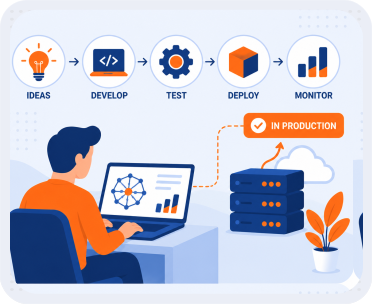
Many organisations have abundant ideas for AI applications but struggle to implement them at scale, and the best teams eliminate this challenge by adopting a high-performing MLOps framework that enables faster and more reliable model deployment. By reducing the time between development and deployment, these teams ensure that organisations can capture value from their AI innovations while also responding to market demands with greater agility. As a result, organisations are prioritising hiring AI talent that can deploy, scale and manage AI solutions seamlessly to reduce the risk of model failures in production.
05They Combine Human Expertise with AI
Many people assume that the most successful organisations will rely on AI to replace human input, particularly in decision-making. The most successful AI teams will augment human expertise rather than replace it. By combining the strengths of both, these teams generate better outcomes while accelerating innovation. This approach also has implications for AI hiring, with organisations looking to hire people who can effectively leverage AI technologies rather than compete with them. In the future, organisations that want to gain a competitive edge will invest in solutions that enable humans to do what they do best while also harnessing the power of artificial intelligence.
06They are Hired for Adaptability, Not Just Technical Skills
AI is a constantly evolving space, with new foundation models, frameworks, and enterprise tools emerging at an unprecedented pace. As a result, technical skills relevant to AI are becoming increasingly obsolete, forcing organisations to rethink their hiring approaches. The best ones are those that can adapt to a rapidly changing environment rather than relying on static technical skills.
Organisations are prioritising individuals with a broader set of skills, including communication, critical thinking, and business decision-making. These competencies will be increasingly important in 2026 as AI technologies continue to evolve at an unprecedented pace.
07They Build Responsible AI Into Every Project
As AI becomes deeply embedded in business processes, organisations must adopt responsible AI practices to mitigate risks and build trust. The advanced AI teams embed responsible AI principles in all stages of the AI lifecycle, from design and development to deployment and monitoring. By prioritising ethics and transparency, these organisations reduce business risks while also enhancing employee confidence and customer trust. For HR leaders, responsible AI also influences the way organisations approach AI hiring, with an emphasis on ethical decision-making and organisational impact. Ultimately, the organisations that will benefit the most from AI are those that build solutions that people are comfortable using.
08They Encourage Continuous Learning
Technology is a primary enabler of AI innovation, but people remain an organisation’s most valuable asset. Successful teams understand this reality and invest in continuous learning, ensuring that their workforce has the skills and competencies to drive business transformation. By encouraging team members to pursue ongoing education and certification, these organisations cultivate a culture of innovation and adaptability.
For HR and talent leaders, continuous learning is an important consideration when building an AI team structure for 2026. It is often more efficient and cost-effective to upskill current employees rather than hire new talent with specialised but niche skills.
09They Measure Success Beyond Model Accuracy
Model accuracy will continue to be a critical consideration in AI development, but the best AI teams understand that it is not the only metric that matters. Organisations must look beyond model accuracy and adopt a broader set of performance indicators, including employee adoption rates, customer satisfaction, productivity gains, and business impact. After all, an AI model with a high degree of accuracy that fails to improve day-to-day operations is ultimately a drawback. By focusing on business outcomes, organisations can ensure that their AI initiatives are delivering tangible value.
10They are Built for Scaling, Not Just for Experiments
Many organisations experiment with AI but fail to scale their efforts, resulting in numerous AI projects that generate little to no business value. The best AI teams avoid this trap by designing their initiatives to be scalable, enabling organisations to capture value from their AI investments. These teams also invest in reusable data and analytics assets, reducing implementation time for subsequent initiatives while also minimising costs. Hiring AI talent that can scale AI initiatives is critical for organisations that want to maximise the value of their AI investments. This allows organisations to continuously capture value from their innovations while also accelerating future initiatives.
In a Nutshell
The future belongs to organisations that understand how to assemble the best AI teams. While many organisations will have access to similar AI technologies, those with the most sophisticated AI teams will be best positioned to benefit from these innovations. Building the best AI teams starts with hiring the right talent before your competitors. Leading organisations are securing the right talent faster by leveraging smart hiring practices. Hiringhood is built to bring in the best AI/ML talent pool in one place where you can hire top talent while reducing the time spent from job posting to hiring by up to 60%.
Organisations that excel at AI in 2026 are those that focus on business outcomes, encourage cross-functional collaboration, and invest in people with the right skills. For HR and talent leaders, the ability to influence the future of AI is closely linked to their understanding of the best AI team structure. In 2026, the best way to prepare for the future of AI is to begin building the best AI teams today.
Share this article:
Copy Link LinkedIn
 Twiter / XEmail
In This Article
1. They are Built Around Business Goals, Not Technology2. They are Cross-Functional by Design3. They Prioritize ROI as Much as Models4. They Move Models Into Production Faster5. They Combine Human Expertise with AI6. They are Hired for Adaptability, Not Just Technical Skills7. They Build Responsible AI Into Every Project8. They Encourage Continuous Learning9. They Measure Success Beyond Model Accuracy10. They are Built for Scaling, Not Just for ExperimentsHire AI/ML Talent in Days, Not Months
Join 500+ companies leveraging Hiringhood to hire exceptional talent with unmatched speed and accuracy.



More from the Hiringhood Blog
The Recruiter’s Guide to Prompting AI Screening Tools
Get better candidate matches by learning how to craft precision role descriptions that AI understands.

The ROI of AI-Powered Screening: A Data-Driven Analysis
An in-depth look at how AI screening tools generate measurable returns across 200+ companies.
India’s Hiring Landscape 2024: Key Stats at a Glance
Visual summary of hiring velocity, top in-demand skills, salary benchmarks, and diversity trends.