
The Ultimate Guide to AI Tools for Recruiters in 2026
Accelerating AI-powered hiring with smarter recruitment tools.

Asha Kiran Nambala
Digital Marketing Manager • Hiringhood
Recruiting has shifted more in the last two years than it did across the previous two decades combined. Teams are under pressure to close roles quickly, screen with more accuracy, and stop good candidates from walking away mid-process - and that pressure is what's turned AI recruiting tools from a curiosity into something closer to standard equipment for any serious talent acquisition function.
The data is clear: 88% of global enterprises now use AI for first-pass screening, and 51% have automated parts of sourcing, outreach. And separately, the global talent shortage is on track to cost businesses an estimated $5.5 trillion by the end of 2026 if companies don't adapt.
For organisations hiring AI/ML and Data talent in India specifically - a market where demand has been outpacing supply for a while now - this isn't an abstract trend. It's the gap between a generalist hiring process that often drags past 90 days for a specialised role, and a domain-built approach that can close the same role in under a week.
01 Why AI Has Become Central to Hiring, Not Just Helpful
Hiring used to run on patience. You posted a role, waited for resumes, screened them by hand, and booked calls one by one tolerable only because talent was easy to find and speed didn't matter.
Today it's the opposite.
70%
DROP IN SOURCING TIME
7 Days
AVERAGE TIME-TO-HIRE
83%
offer acceptance rate
40-50%
TALENT ACQUISITION COST SHRINK
02 Inside the AI Hiring Workflow, Stage by Stage
Workforce Planning and Writing the JD
AI starts before the role is even posted, reading headcount, attrition, and market signals to flag where hiring needs will emerge next. Writing the job description? A bias-checked draft lands in minutes, not hours.
Finding Passive Candidates
This is where dedicated sourcing tools earn their keep. AI sourcing platforms such as HireEZ and Fetcher, alongside AI-powered ATS systems like TurboHire, work across professional networks like LinkedIn, developer hubs like GitHub and Stack Overflow, and traditional job boards to assemble candidate pools automatically—including people who've never applied to anything and aren't actively job hunting.
Screening and Scoring Candidates
Once candidates land in the pipeline, AI scoring models step in to rank them against what the role actually requires. Rather than matching keywords, these models evaluate experience patterns, career progression, project fit, technical assessments, and problem-solving ability.
Pre-Screening Through Chatbots and Voice Bots
Conversational tools like Paradox's Olivia handle the first round of candidate touchpoints—confirming interest, checking availability, asking qualifying questions, and locking in interview slots automatically.
Making Sense of Video Interviews
AI helps interpret video interviews by highlighting trends, summarizing conversations, and identifying potential risks or strengths. Predictive models also estimate the likelihood of offer acceptance and successful onboarding.
03The AI Recruiting Tools Worth Knowing
AI Assistants For Writing And Research
ChatGPT
Drafting JDs, personalising outreach, generating interview questions
Gemini
Research-heavy sourcing work, plugs neatly into Google Workspace
Claude
Building structured interview frameworks, nuanced writing, compensation benchmarking
Dedicated AI Sourcing Platforms
HireEZ
Searches 800M+ profiles across 45+ platforms with Boolean and AI-ranked output.
Fetcher
Delivers AI-curated batches of candidates straight to your inbox, daily.
TurboHire
Built with the Indian market in mind; strong on sourcing and screening workflows.
ATS And CRM Systems With AI Built In
Loxo
A combined ATS and CRM with AI sourcing; a favourite among agency recruiters.
Ceipal
AI-driven ATS with resume parsing, candidate matching, popular in India, US.
Eightfold.ai
Deep-learning talent intelligence matching people to roles and career paths.
Interview Intelligence Tools
Metaview
Transcribes, summarises, and pulls structured data out of interview conversations.
Paradox (Olivia)
Conversational AI handling candidate engagement, scheduling, and pre-screening at volume.
04The AI/ML and Data Talent Problem in India - Where General Tools Fall Short
General-purpose AI recruiting tools do a perfectly good job for standard roles. But once you're hiring for AI engineers, ML engineers, MLOps engineers, Data Engineers, or Generative AI engineers, the gap between "a good tool" and "the right tool" becomes hard to ignore.
The real difficulty isn't sourcing candidates - it's knowing precisely what you're looking for in the first place. Without genuine technical depth behind the screening, it's tough to tell apart someone with hands-on production ML experience from someone whose exposure is purely academic. Generic scoring models simply weren't designed to catch that distinction.
This is exactly the gap Hiringhood was built to close. The platform works exclusively on AI/ML and Data talent hiring in India - its AI handles job description drafting, scores and ranks candidates against benchmarks specific to AI/ML roles, and coordinates sourcing through a network of 1,000+ specialist recruitment agencies.
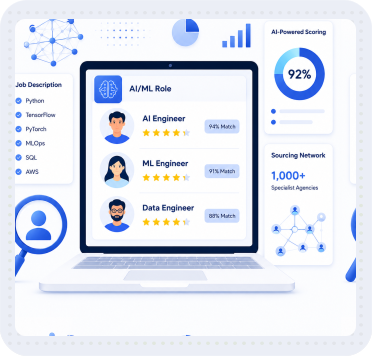
Roles typically close in under 7 days - a direct result of the sourcing network, scoring model, and candidate pool all being calibrated around one talent category, rather than stretched thin across every role type imaginable. For companies hiring AI/ML talent in India, from early-stage startups to enterprises like Wipro and ATMECS (now part of Sutherland), that level of specificity tends to matter more than the broader feature set of a general-purpose platform.
05How to Actually Evaluate AI Recruiting Tools
Can the platform explain its scores?
If a candidate gets ranked at the top, you should be able to ask why and get a real answer - not a black box. Scores you can't defend internally are scores you'll struggle to act on.
Look for evidence of bias reduction, not just claims of it.
Ask vendors directly how their models were trained and what kind of audits, if any, they've run. Without careful management, training data can quietly encode and then scale existing bias.
Check whether it actually plugs into your stack.
An AI sourcing tool that doesn't talk to your ATS just adds a second system to manage - which is more work, not less.
Understand the difference between specialised and generalised.
For AI/ML hiring in India: whether you're an early-stage startup or an enterprise like Wipro or ATMECS (now part of Sutherland), specificity beats a broad, general-purpose feature set.
06Where AI Still Hits Its Limits
AI is genuinely good at handling volume, staying consistent, and moving fast. Judgment calls are a different story entirely. Whether a candidate is moving for the right reasons, how they'll actually mesh with a specific team's dynamic, whether they're likely to stick around for years rather than months - these remain fundamentally human assessments. AI can surface useful signals along the way. People still have to interpret what those signals actually mean
The hiring teams getting the best results in 2026 haven't outsourced the process to AI wholesale. They've used it to strip out the low-value, repetitive work - freeing up time for the decisions that genuinely require a human in the room.
07Bringing It Together
AI recruiting tools aren't a nice-to-have anymore, they're the backbone of fast, accurate, scalable hiring. Teams that have woven AI into sourcing, screening, and scheduling close roles faster, and better, than those running it all by hand.
For most standard roles, the tools covered here give you a solid starting point. But for AI/ML and Data hiring in India specifically, the platform you choose needs to be built for that exact problem from the ground up.
Share this article:
Copy Link LinkedIn
 Twiter / XEmail
In This Article
1. Why AI Has Become Central to Hiring, Not Just Helpful2. Inside the AI Hiring Workflow, Stage by Stage3. The AI Recruiting Tools Worth Knowing4. The AI/ML and Data Talent Problem in India - Where General Tools Fall Short5. How to Actually Evaluate AI Recruiting Tools6. Where AI Still Hits Its Limits7. Bringing It TogetherHire AI/ML Talent in Days, Not Months
Join 500+ companies leveraging Hiringhood to hire exceptional talent with unmatched speed and accuracy.



More from the Hiringhood Blog
The Recruiter’s Guide to Prompting AI Screening Tools
Get better candidate matches by learning how to craft precision role descriptions that AI understands.

The ROI of AI-Powered Screening: A Data-Driven Analysis
An in-depth look at how AI screening tools generate measurable returns across 200+ companies.
India’s Hiring Landscape 2024: Key Stats at a Glance
Visual summary of hiring velocity, top in-demand skills, salary benchmarks, and diversity trends.